Bay and Bow Window Blinds: Shades, Curtains and How to Fit Them
A bay window is often the best seat in the house, and one of the trickiest windows to dress. The angles, corners and window seats all need a plan.
In short
- Most bays get one shade per window, mounted so the corners meet neatly.
- Curtains on a track bent to the bay can cover the whole thing in one sweep.
- Shades plus side drapery is the most popular combination.
- Motorizing a bay lets every panel move together.
On this page
What makes bays tricky
A bay has three or more windows set at angles. Each one needs its own covering, and where they meet at the corners, the headrails or cassettes can collide. Bays also tend to have deep sills or window seats, and bow windows (a gentle curve of four or five windows) multiply the problem.
Option 1: A shade for each window
The most common approach. Each window gets its own shade, sized so the cassettes meet at the corners without touching.
- Inside mount looks tidy and keeps the sill or seat free, if the frames are deep enough.
- Outside mount covers more of each window and hides uneven frames, but the corners need careful planning.
- Matching bottom lines: set favourite positions, or motorize, so every shade stops at the same height.
Roller, zebra, honeycomb and Roman shades all work. Honeycomb top-down/bottom-up shades are excellent in street-facing bays: see top-down/bottom-up shades.
Option 2: Curtains on a bent track
A curtain track can be bent to follow the bay, so drapery runs around the whole window in one sweep. Ripple-fold glides most smoothly around the angles. Closed, it turns the bay into a cosy alcove; open, it stacks neatly at the ends. See motorized curtains and tracks.
Option 3: Shades with side drapery
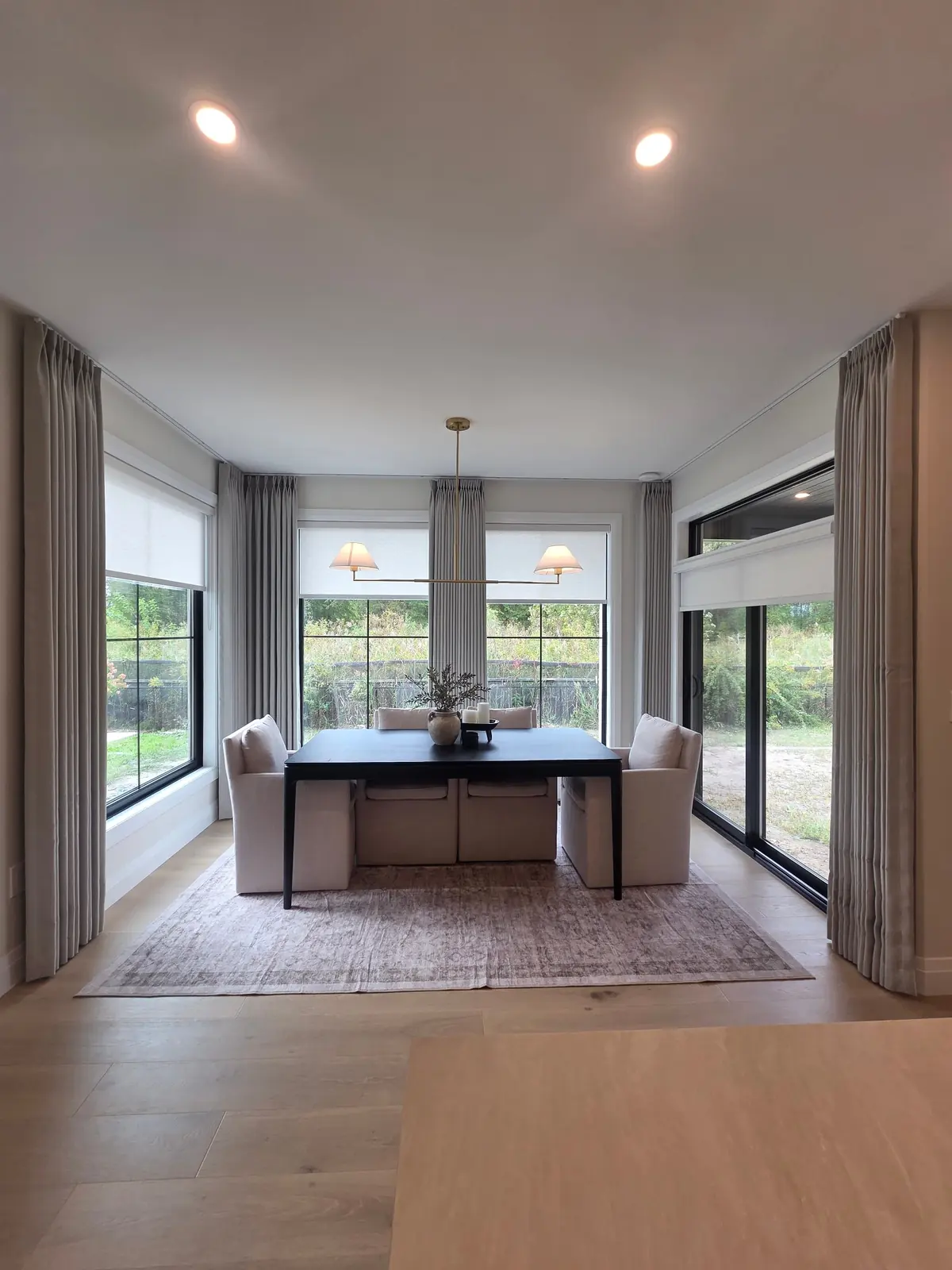
Shades handle light and privacy at each window, and stationary or working drapery at the ends of the bay frames the whole thing. It's the combination we install most in living and dining rooms.
Bow windows
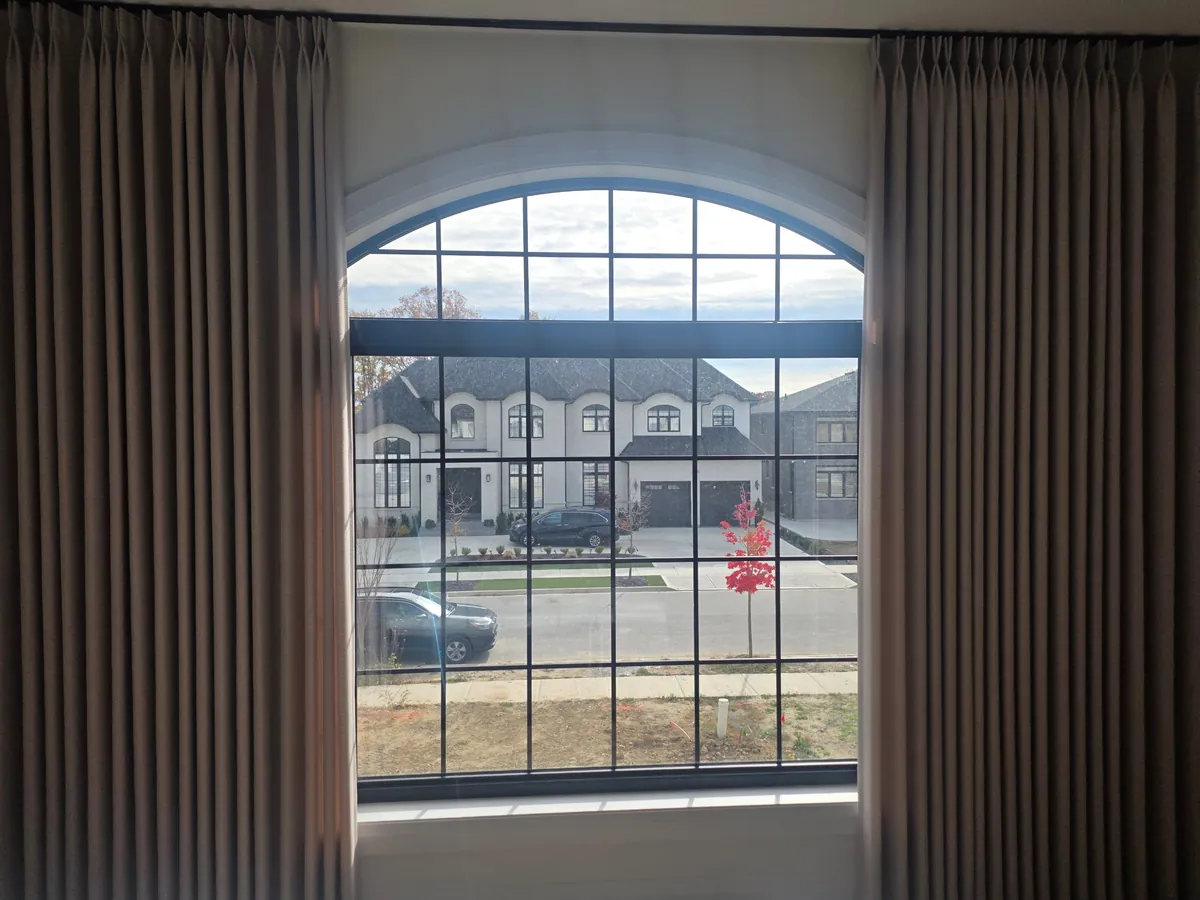
Bow windows have more, narrower panes on a gentle curve. Individual shades work but make for a lot of cassettes; a curved curtain track is often cleaner, with or without slim shades behind it.
Window seats
If the bay has a seat, choose inside-mounted shades that stop above the cushions, or curtains that hang in front of the seat. Cordless or motorized lifts keep cords away from where people sit and children climb.
Privacy and light
Bays often face the street. Top-down/bottom-up shades let light in over the top while covering the lower glass; zebra blinds give privacy with light through the day. See privacy without losing daylight.
Motorizing a bay
Three to five shades in one bay are ideal for motors: group them on one button and they move together and stop level. See are motorized blinds worth it.
Common questions
Can one blind cover a whole bay window?
Not a single flat blind, because of the angles. Curtains on a track bent to follow the bay can cover it in one sweep.
How do you avoid gaps at the corners of a bay?
We size each shade so the cassettes meet at the corners without touching, and use outside mounts or side drapery where the gaps would show most.
Can bay window shades move together?
Yes. Motorized shades can be grouped so every window in the bay opens and closes together and stops at the same height.